
The Government will pay Central Bedfordshire about £56m to wipe out 90% of its SEND deficit after approving its reform plan. Here is what changes for schools.
The Government is set to pay Central Bedfordshire Council almost £56 million to wipe out most of the debt it has built up on special educational needs.
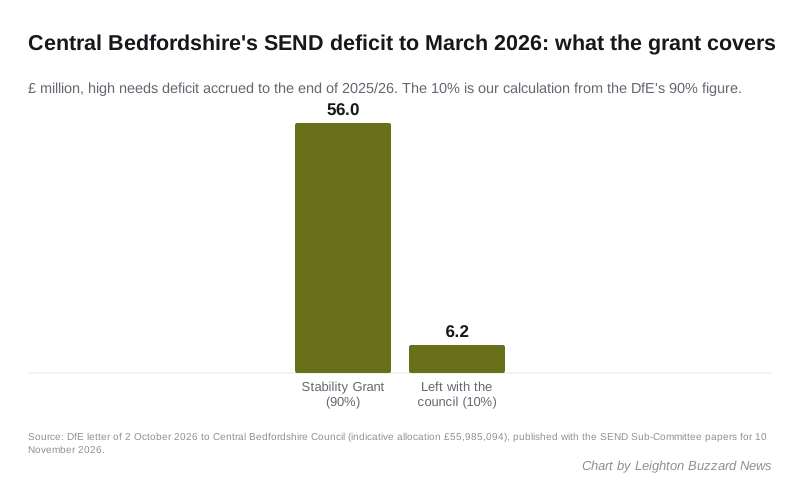
The Department for Education approved the council’s Local SEND Reform Plan on 2 October. Its approval letter says that makes the council eligible for a High Needs Stability Grant of £55,985,094. The grant covers 90% of the deficit the council had run up on its high needs budget by the end of March 2026.
The letter was published with the papers for the council’s SEND Sub-Committee on 10 November. It says payment is expected on 30 November 2026. (DfE letter, Appendix B)
The money is not yet final. The DfE says the allocation will be confirmed in writing and could change once the council’s accounts for 2025/26 are audited. The council’s own report says the sum should not yet be “reported as finally settled or received”. (SEND Reform Plan update)
In June, councillors were told that around £56 million could be written off if the plan was approved. We reported that in our story on the EHC plan backlog. The approval letter is the first published confirmation of the figure.
What the deficit is
Councils pay for SEND support in schools from the high needs block of the Dedicated Schools Grant. When spending runs ahead of that grant, the shortfall builds up as a deficit on the council’s books.
A grant covering 90% of the deficit means the total stood at roughly £62.2 million at the end of March 2026. That is our calculation from the DfE’s figures, not a number the council has published. It would leave around £6.2 million that the grant does not cover.
The grant does not cover deficits from this year onwards. The DfE letter says support for deficits in 2026/27 and 2027/28 will be “appropriate and proportionate, though it will not be unlimited”. It adds that future help will depend on how well the council delivers its plan.
What changes for schools
The main change is a scheme called Experts at Hand, run through what the council calls Team Around the School. A school works with one group of specialists instead of making separate referrals. The group includes:
- educational psychologists
- SEND advisory teachers
- speech and language therapists
- occupational therapists
- mental health practitioners
The report says the aim is to get help to children earlier, without waiting for a diagnosis or an Education, Health and Care Plan (EHCP).
The scheme has been tried in seven schools. Around 19 more will join from January 2027, picked on the share of pupils with EHCPs, pupils on SEN Support and pupils eligible for free school meals. The report does not name the schools. The DfE has given the council £2.266 million to set the scheme up.
The SNAP Parent Carer Forum is also building a Parent Navigator service, run by parents, to help families find their way through SEND support. The report says it should launch in the spring term.
The figures behind the plan
The approved plan sets out where Central Bedfordshire stands. (Local SEND Reform Plan, Appendix A)
| Measure | Figure |
|---|---|
| Children identified with SEND | 17.7% |
| Children with an EHCP | 6.3%, up 148% since 2019 |
| Children with an EHCP taught in mainstream schools | 68.9% |
| Children in special schools outside the area | 251 |
| EHCPs issued within the 20-week limit | 74% |
| Annual review decisions made on time | 53.8% |
The plan admits that families’ experience is still “inconsistent”. It also says attendance and attainment are below the national average.
The DfE’s approval came with conditions. It wants clearer accountability from the NHS, quarterly reviews and evidence that families are seeing a difference. The council must send it data every quarter.
What it means for you
- If your child has an EHCP or is waiting for one, nothing changes in law. The council’s report says its legal duties on assessments, plans and placements stay the same, and the new scheme is “not to deter legitimate requests”.
- If your child is at one of the 19 schools joining in January, the school should start working with the specialist team next term. Ask the school’s SENDCO whether it has been chosen.
- For council tax payers, the deficit sits on the council’s books. If the grant is paid as expected, 90% of what had built up by March 2026 is cleared. The council still has to stop new deficits building up.
The full minutes of the 10 November meeting have not yet been published. Our council tax bands page has this year’s charges for Leighton-Linslade.
Have your say