
Twelve pupils who applied on time had no transport on the first day of term, the council's review says. It plans a 31 May deadline for all schools from 2027.
Central Bedfordshire Council says parts of its school transport service “fell short of the standards children, young people and their families should reasonably expect” when term started in September.
Its review of the start of term goes to an extraordinary meeting of the Sustainable Communities Overview and Scrutiny Committee on Thursday 26 November, at 1.30pm. Councillors are asked to note it. (Central Bedfordshire Council, Home to School Transport, report to the committee, 26 November 2026)
Overview
- 12 mainstream pupils who applied on time had no transport on the first day of term. That is 0.3% of the mainstream total.
- 3,827 mainstream pupils had transport on day one. Another 171 had it arranged later, and 159 of those had applied after the deadline.
- SEND transport: 92% of 990 pre-16 students had transport by the end of the first week, and 73% of 410 post-16 students.
- Complaints: 21 of 63 complaints about September and October were fully upheld and nine partly upheld. Late transport was the most common reason.
- Next year: one mainstream deadline of 31 May for every school, a fixed application window from March 2027, and paid seats for non-eligible pupils not offered until 1 October 2027.
What went wrong in September
The September changes came all at once, the report says. They included:
- re-letting most mainstream bus contracts, for the first time in about a decade
- new digital travel passes and safeguarding checks on boarding
- a new eligibility rule, based on the nearest suitable school rather than catchment
- moving school transport phone calls to the council’s main contact centre in January
The report then sets out individual failures on the first days of term. It names some routes, but none in Leighton Buzzard or Linslade:
- On the first day, a mainstream bus did not collect its pupils. An officer had changed the route but had not confirmed it with the operator, Herberts, before going on extended leave. The pupils were collected that afternoon.
- One SEND student on the Fleet route was not collected all day because of a wrong timetable.
- Three students were put on the wrong route. Parents were told the evening before term and offered refunds of any costs.
- An operator could not run the Henlow7 route, affecting about 70 students. Another operator stepped in on the same timetable.
- An operator turned down two contracts the day before they began. It took several days to arrange transport for three students on the Sandy10 route.
- Two students were found to be allocated to a route that had stopped running in July 2026.
Some pupils who used to take a school bus were moved to taxis while the council checked capacity. The report says some parents were unhappy that their children were no longer travelling with their friends.
On one Arriva public bus, 17 eligible students struggled for space. The council has now commissioned a dedicated minibus for them.
How many were affected
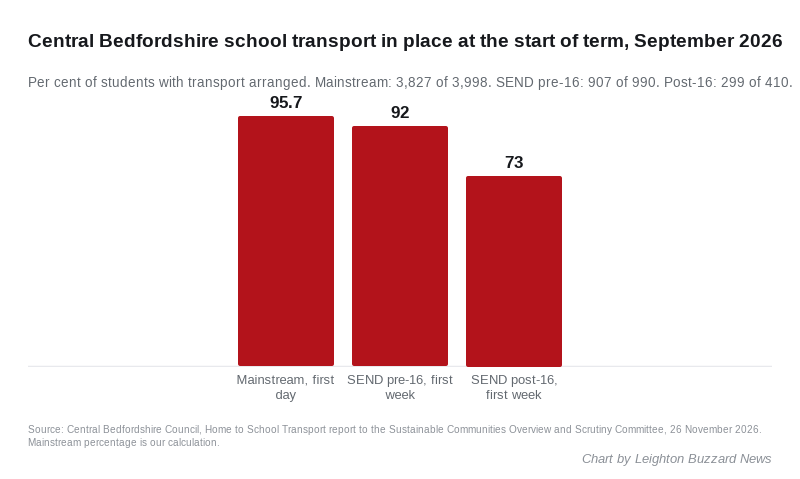
The council arranged transport for 3,827 mainstream students for the first day. A further 171 had theirs arranged after term began. By our calculation, 3,827 of those 3,998 students is 95.7%. (Central Bedfordshire Council, Home to School Transport report)
For SEND students, the council arranged transport for 990 pupils under 16. Of those, 907 had it by the end of the first week. For 410 post-16 SEND students, the figure was 299. The rest followed during September.
The council argues that a later start does not always mean a delay. Some special schools and colleges use phased or staggered starts, so transport may have begun on the student’s first day in class.
Appeals and complaints
Between February and October, 2,639 families applied for school transport, 20 fewer than in 2025. More were turned down: 467, up from 442. The report says the new nearest-school rule “may be contributing” to that.
The figures on appeals and complaints were:
| 2025 | 2026 | |
|---|---|---|
| Stage 1 appeals | 191 | 147 |
| Stage 2 appeals | 27 | 41 |
| Online contact cases, February to October | 8,029 | 7,661 |
| Phone contacts, July to October | 4,360 | 4,040 |
Of the 147 first-stage appeals this year, 21 were upheld. Of the 32 second-stage appeals heard so far, four were upheld, and nine more are due to be heard this month.
There were 63 complaints about September and October. The council fully upheld 21 and partly upheld nine. Late transport was the issue in 15 of those 30. The report says no school transport complaint has been upheld by the Local Government and Social Care Ombudsman in the past two years.
The report also complains about the workload. It says 110 parents sent 123 duplicate applications, and one parent contacted the team 17 times about one child. Councillors raising cases for residents also “placed additional demands on officers”, it says.
What changes for September 2027
The council’s improvement plan for next year covers six areas: applications, route planning, information for families, handling enquiries, checks before term starts, and work with schools and operators. (Central Bedfordshire Council, Appendix F, September 2027 Mobilisation Improvement Plan)
The changes that matter most to families are:
- One deadline, 31 May, for every school. At the moment the mainstream deadline is 31 March for secondary and upper schools and 19 May for primary, lower and middle schools.
- A fixed application window. The standard form would open in March 2027 and close at the deadline, as school admissions do. Today the form stays open all year.
- A separate route for late applications. Families who apply late are already told transport may not be in place until October half term, and that warning stays.
- Five tracking stages for each application, from “Application submitted” to “Transport confirmed or declined”.
- Paid seats from 1 October 2027. Pupils who are not eligible can buy a spare seat on a school route. Applications for these would open on 1 October 2027, a month after term starts, and seats would be offered a term at a time.
Separate routes would stay open all year for moves of house or school, SEND placements and post-16 places. The report says emergency contracts for late applicants can cost more than routes bought in the normal way. (Central Bedfordshire Council, Home to School Transport report)
What it means for you
If your child will need free school transport from September 2027, the plan gives you longer to apply: until 31 May, whatever kind of school it is. That matters in Leighton Buzzard, which still has lower, middle and upper schools and so had two different deadlines. Apply inside the window, because a late application goes to a separate queue.
If you pay for a spare seat because your child is not eligible, the plan means you would not hear until October 2027 at the earliest. Plan another way to get to school for the first weeks of that term.
If you disagree with a transport decision, the council’s school transport appeals page explains the two stages.
The committee meeting on Thursday 26 November is public. It starts at 1.30pm, or when the earlier Audit Committee finishes. Councillors first raised the start-of-term problems at the same committee in September, as we reported then.
Sources
- Central Bedfordshire Council: Home to School Transport, report to the Sustainable Communities Overview and Scrutiny Committee, 26 November 2026
- Central Bedfordshire Council: Appendix F, September 2027 Mobilisation Improvement Plan
- Central Bedfordshire Council: Extraordinary Sustainable Communities Overview and Scrutiny Committee, 26 November 2026, agenda and papers
Have your say