
Cllr Adam Zerny's motion tonight backs an elected mayor over an Ox-Cam region and asks for a public vote. The government's own statement offers no referendum.
The leader of Central Bedfordshire Council asks councillors tonight to back an elected mayor for this part of England, and to say the region should get a public vote before anything is settled. The motion is the second of two items at an extraordinary Full Council at 6.30pm on Wednesday 2 September. (Central Bedfordshire Council, agenda for Full Council, 2 September 2026)
Councillor Adam Zerny, an Independent who represents Potton and who chairs the council’s executive, is the proposer. His motion asks Full Council to agree four things:
- to support the leader in continuing to talk to government about devolution, and to welcome “the recent clarity over funding and governance”
- that there are “clear benefits both in terms of funding and powers, in adopting a mayoral, rather than non-mayoral approach”
- that a strategic authority covering “a large part of the Ox Cam region” would be “far more powerful than purely Bedfordshire and Milton Keynes”
- that “there should be a Government funded public vote in the region, before a final go ahead”
(Motion proposed by Cllr Zerny, Devolution)
The motion is not a decision. It commits the council to nothing beyond a view, and its own final line says the council “looks forward to seeing the finer detail before making a final decision”. But it is the clearest public statement yet of where the council’s leadership wants this to end up.
Why this is happening now
On 31 July 2026 the Cabinet published a statement called Rewiring the State. One sentence in its delivery section put tonight’s motion on the agenda. Ministers were “writing today to those areas without a strategic authority to confirm whether they wish to proceed with a mayoral or non-mayoral approach”. Central Bedfordshire is one of those areas. (Rewiring the State, Cabinet Statement, 31 July 2026)
The statement sets an end point. The government’s ambition is that “every area in England has, or is in the process of establishing, a strategic authority by the end of 2027, with strategic authorities in place everywhere by the end of 2028”.
It is also blunt about the choice. The government “will not impose mayors on areas that do not want one”, it says. But it adds that “directly accountable mayors represent the strongest form of governance available, and so the suite of powers available to areas with mayors will be commensurately greater”. Areas that are not ready get a non-mayoral “foundation strategic authority with an enhanced set of powers”.
That asymmetry is the whole of Councillor Zerny’s second point.
What a mayor would actually get
The statement is specific about money, and the dates are close.
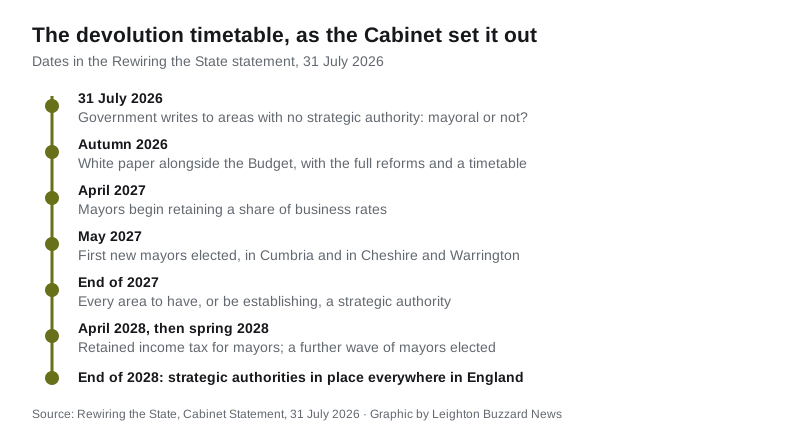
- Autumn 2026: a white paper alongside the Budget and a fiscal devolution roadmap, setting out the full reforms and a timetable
- April 2027: mayors begin retaining a share of business rates
- May 2027: the first new mayors are elected, in Cumbria and in Cheshire and Warrington
- March 2028: all strategic authorities able to set out plans for an Overnight Visitor Levy
- April 2028: grants from central government start being replaced by a share of local income tax for every mayor
- Spring 2028: a further wave of new mayors elected
Beyond money, the statement promises deputy mayor roles with responsibility for key public services, and says regional police forces, fire and rescue services and Integrated Care Boards will align with strategic authority boundaries “by the end of the Parliament”. Mayoral intervention powers in the planning system are among the steps ministers said they would activate “over the coming weeks and months”.
The same statement conferred established mayoral strategic authority status on four further areas: Cambridgeshire and Peterborough, the East Midlands, the West of England, and York and North Yorkshire.
The two things the motion asks for that nobody has defined
First, the region. The motion prefers an authority covering “a large part of the Ox Cam region” over one covering Bedfordshire and Milton Keynes alone. The government’s own Oxford-Cambridge Growth Corridor prospectus does not draw that boundary. It describes “deepening the links between Oxford and Cambridge, Milton Keynes, Bedford and beyond”, and puts the region at 3.5 million people, without listing which councils are in it. (Oxford-Cambridge Growth Corridor Investment Prospectus, updated 19 May 2026)
Central Bedfordshire already sits in the overlapping bodies. Councillor Zerny’s register of council appointments lists him on England’s Economic Heartland Strategic Transport Leadership Board, the Central Area Growth Board and the SEMLEP board. (Councillor details, Cllr Adam Zerny)
Second, the vote. We have read the Cabinet Statement in full. It contains no promise of a referendum, government funded or otherwise, anywhere in England. It says only that the government “will not impose mayors on areas that do not want one”. It wants every area that is ready to have a mayor as soon as possible, “as long as there is strong local support”.
How strong local support is to be measured is not stated. On the government’s published position, a public vote in this region is something the council would have to persuade ministers to fund, not something already on offer.
The motion’s last line also names a “Devolution Briefing Note August 2026”. That document is not published with the agenda, and the reports pack does not contain it.
What it means for you
Nothing changes to any council service as a result of tonight’s vote. Bins, council tax, planning and roads all stay with Central Bedfordshire Council either way. A strategic authority is a layer above existing councils, not a merger of them, and the Cabinet Statement is explicit that “strategic authorities are only as strong as the local authorities that constitute them”.
What is being decided over the next two years is who sets transport, skills and strategic planning policy for a region that would take in Leighton Buzzard, and whether that person is elected by you.
Three dates to hold on to:
- Tonight, 6.30pm. The meeting is webcast live from Priory House in Shefford, and recordings are normally posted within 24 hours. (Central Bedfordshire webcast library)
- This autumn. The government’s white paper, published alongside the Budget, is where the actual timetable and the legislation appear.
- End of 2027. The government’s deadline for every area in England to have a strategic authority, or to be in the process of establishing one.
The other motion tonight asks the executive to resume issuing organisational blue badges to community minibus services: what that vote is about.
Have your say