
Councillors vote tonight on restoring organisational blue badges to Buzzer Buses. The executive refused in June, saying government rules bar them.
Central Bedfordshire councillors meet tonight to vote on whether the council should start reissuing organisational blue badges to community minibus services in Leighton Buzzard, Linslade, Houghton Regis and Dunstable. The meeting is an extraordinary Full Council at 6.30pm on Wednesday 2 September, and the blue badge motion is one of only two items on the agenda. (Central Bedfordshire Council, agenda for Full Council, 2 September 2026)
The motion is proposed by Councillor Steve Owen, an Independent who represents Leighton Linslade West. It asks Full Council to urge the council’s executive “to direct officers to resume the re-issue of OBBs to all CVTOs operating within the CBC area as a matter of urgency”. (Motion proposed by Councillor Owen, Organisational Blue Badges)
Full Council cannot make the change itself. The blue badge scheme is run by the executive, so the most this vote can do is press the executive to think again. It already said no once, on 2 June.
What an organisational blue badge actually does
A blue badge is normally issued to a person. An organisational badge is issued to a body instead, and can be displayed in any of its vehicles while it is carrying someone who would qualify for a badge in their own right.
For a door to door minibus service, that is the difference between parking outside a surgery door and parking wherever a badgeless van has to park. It matters only on street: the council’s own report notes that blue badge concessions are not legally enforceable on private land such as hospital and supermarket car parks, where it is the landowner’s decision. (Central Bedfordshire Council, Eligibility of Community Transport Services for Organisational Blue Badges, 2 June 2026)
Government guidance says an organisation may be eligible if it both cares for or assists people who need a blue badge and transports people who need a blue badge. It gives residential care homes, hospices and council social services departments as the sort of body that might qualify. Taxi, private hire and community transport operators are unlikely to, it says, “as they are not usually concerned with the care of disabled people”. (GOV.UK, Can I get a Blue Badge?)
That single sentence is the whole argument.
The council’s case for refusing
The report the executive considered on 2 June was written by Iain Melville, the council’s head of financial operations, and presented by Councillor John Baker, the executive member for finance and highways. It sets out four conditions the council says must all be met before an organisational badge can be issued:
- the organisation is concerned with the care of disabled people
- the organisation both cares for and transports disabled people
- the people being transported would qualify for a blue badge in their own right
- there is a clear operational need for an organisational badge rather than using the passengers’ own badges
The report defines “care” narrowly. It means “direct responsibility for disabled people’s welfare”, with transport secondary to that, and it gives nursing homes, residential care homes, day centres and special schools as the examples. It adds that a qualifying service should ideally have a Care Quality Commission registered manager or Ofsted equivalent, and that a personal assistant would probably be needed on the vehicle.
Two details in the report show how tightly the council is drawing the line. Its own fleet does not hold organisational badges. Two of its buildings, Linsell House and Silsoe Horticultural Centre, do.
The report says councils have no discretion to vary the national criteria. Issuing badges outside the framework, it argues, would expose the council to four risks:
- legal challenge or audit criticism
- decisions inconsistent with other authorities
- increased misuse of disabled parking bays
- reputational damage and reduced public confidence in the scheme
It also says further guidance on organisational badges is expected from the Department for Transport shortly, without giving a date.
The executive agreed all three of its recommendations unanimously. They were to note the framework, to endorse the consistent application of the criteria, and to endorse officers working with community transport providers on alternatives for the times a passenger’s own badge cannot be used. (Executive, 2 June 2026, item 13)
What the council’s own enforcement day found
One of the risks the report lists is “increased misuse of disabled parking bays”. Six weeks after the executive’s decision, the council put a number on that risk.
On Thursday 30 July its enforcement team checked blue badges in council car parks and on vehicles parked on double yellow lines in Leighton Buzzard, Dunstable, Houghton Regis, Potton, Biggleswade and Sandy. Officers examined 110 badges. In one case the badge holder was not present, which prompted further investigation. Five vehicles were parked in disabled bays with no valid badge on display and were given penalty charge notices. (Central Bedfordshire Council, Stepping up enforcement on Blue Badge misuse)
Councillor Baker, the same executive member who presented the June report, said in that announcement that misuse “is not a victimless offence” and that badges “must never be used by friends, family members or organisations when the badge holder is not present”. Anyone convicted faces the badge being confiscated and fines and costs of up to £1,500. Misuse can be reported on 0300 300 4154.
Scrutiny asked for the opposite, and set up tonight’s vote
The reason there is an extraordinary meeting at all is printed in the council’s own report. Under “Overview and Scrutiny Comments/Recommendations”, it records that scrutiny councillors asked the executive to:
- work with officers to review national legislation and guidance, “supporting all lawful means to enable Dial-a-Ride and Buzzer Buses to meet the eligibility criteria to receive a Blue Badge”
- refer the matter to Full Council if that was not achievable
- make representations to local MPs and the Department for Transport seeking clarification and a possible review of the guidance
The first was not achievable, on the executive’s own reading. So the second has happened.
Councillor Owen’s motion says operators gave evidence to the sustainable communities scrutiny committee on 16 April, describing how their vehicles have been converted and how drivers are trained to care for disabled passengers. We could not read the papers for that meeting: the committee’s listing on the council’s website runs from 11 June 2026 straight back to 12 June 2025, with nothing in between.
Who this is about
Buzzer Buses (Dial a Ride) Ltd is a Leighton Buzzard charity, number 1109107. It runs seven minibuses fitted with hydraulic tail lifts, fold-down steps and handrails, covering roughly a ten-mile radius of Leighton Buzzard and Linslade. Drivers are MiDAS-trained and DBS-checked, the vehicles run under Section 19 permits, and membership costs £10. (Buzzer Buses)
The motion’s most awkward point for the council is about everywhere else in the district. Disabled transport in the north of Central Bedfordshire is run by a different charity, it says, and that charity does hold organisational badges. They were issued by Bedford Borough Council, after Central Bedfordshire refused to reissue them.
The motion names the places covered that way: Ampthill, Shefford, Biggleswade, Potton, Barton, Sandy, Aspley Guise, Woburn and others. The service is Door to Door, run by Bedfordshire Rural Communities Charity. BRCC, charity number 1061538, confirms on its own site that Door to Door covers Bedford Borough and northern Central Bedfordshire with wheelchair accessible minibuses. (BRCC, Door to Door)
The motion argues that the effect is to treat residents of Leighton Buzzard, Linslade, Houghton Regis and Dunstable differently from the rest of the council’s area. It also lists thirteen neighbouring authorities it says issue organisational badges, among them Bedford, Luton, Milton Keynes, Buckinghamshire, Hertfordshire and Cambridgeshire, plus every London borough.
Both of the motion’s footnotes make the same complaint: neither point was mentioned in the paper the executive saw on 2 June. We have read that report in full. It does not:
- name Bedford Borough Council
- mention badges issued by another authority to a service operating in this district
- set out any other council’s practice, beyond one sentence saying its own approach “is consistent with the vast majority of other council’s, including our neighbours”
What the council pays for community transport
The report puts one number on the table. Central Bedfordshire pays £352,600 to dial-a-rides in the district. Most of it is not what a reader would think of as dial-a-ride money.
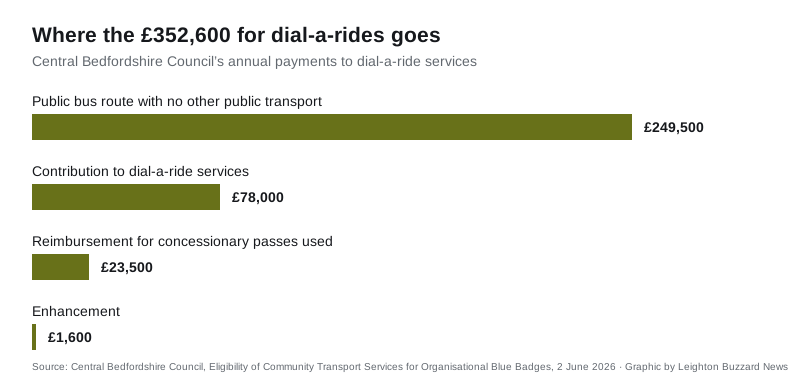
- £249,500 for a public bus route where there would otherwise be no access to public transport
- £78,000 as a contribution to dial-a-ride services
- £23,500 reimbursing concessionary passes used
- £1,600 described only as an enhancement
What it means for you
If you or someone you care for uses Buzzer Buses, nothing changes today. The service runs either way. What is at stake is where the minibus can stop and park while you are getting in or out of it, and how far you have to walk at the other end.
If you hold your own blue badge, take it with you. The council’s position is that passengers’ individual badges should be used, and its officers are working with operators on what to do when a passenger does not have one.
Three things you can do:
- Watch tonight. The meeting is webcast live from Priory House in Shefford at 6.30pm, and a recording is normally posted within 24 hours. (Central Bedfordshire webcast library)
- Note what the agenda does not include. This extraordinary meeting has four items: apologies, members’ interests, the chairman’s announcements, and the two motions. There is no public questions or petitions item, unlike the executive’s normal agenda.
- Take it to a committee that does hear the public. The sustainable communities scrutiny committee meets at 9.30am on Thursday 10 September, and the Leighton-Linslade Partnership Committee meets at 7pm the same day.
Councillor Owen can be contacted at steve.owen@centralbedfordshire.gov.uk. The other item tonight is a motion on devolution from the council’s leader, Councillor Adam Zerny.
If you are looking for where you can already park with a badge in town, see our guide to parking in Leighton Buzzard.
Have your say