
A five-year plan to rescue the Tuesday market goes to councillors on Monday. 85% of traders now work Saturdays only, and 45% of shoppers are not regulars.
A five-year plan for Leighton Buzzard Market goes before town councillors on Monday 14 September, and its central problem is stated plainly in the document itself: Tuesday is losing traders while Saturday grows.
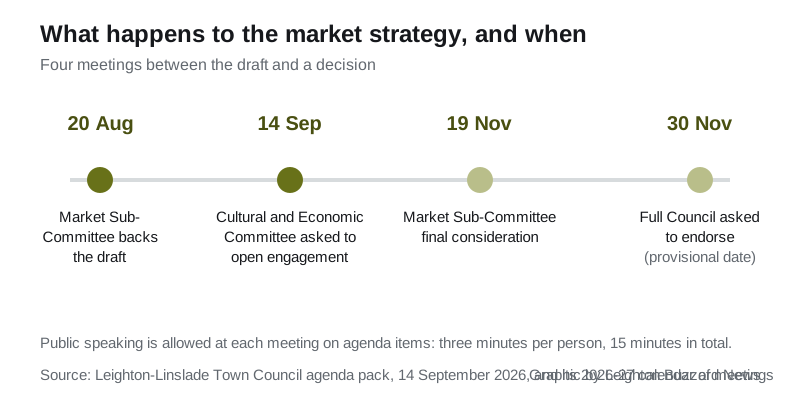
The draft Leighton Buzzard Market Strategy 2026-2031 is published in full in the agenda pack for the town council’s Cultural and Economic Committee. The committee is asked to send it out for a period of informal engagement before it returns for final consideration in November. (Leighton-Linslade Town Council, Cultural and Economic Committee agenda pack, 14 September 2026)
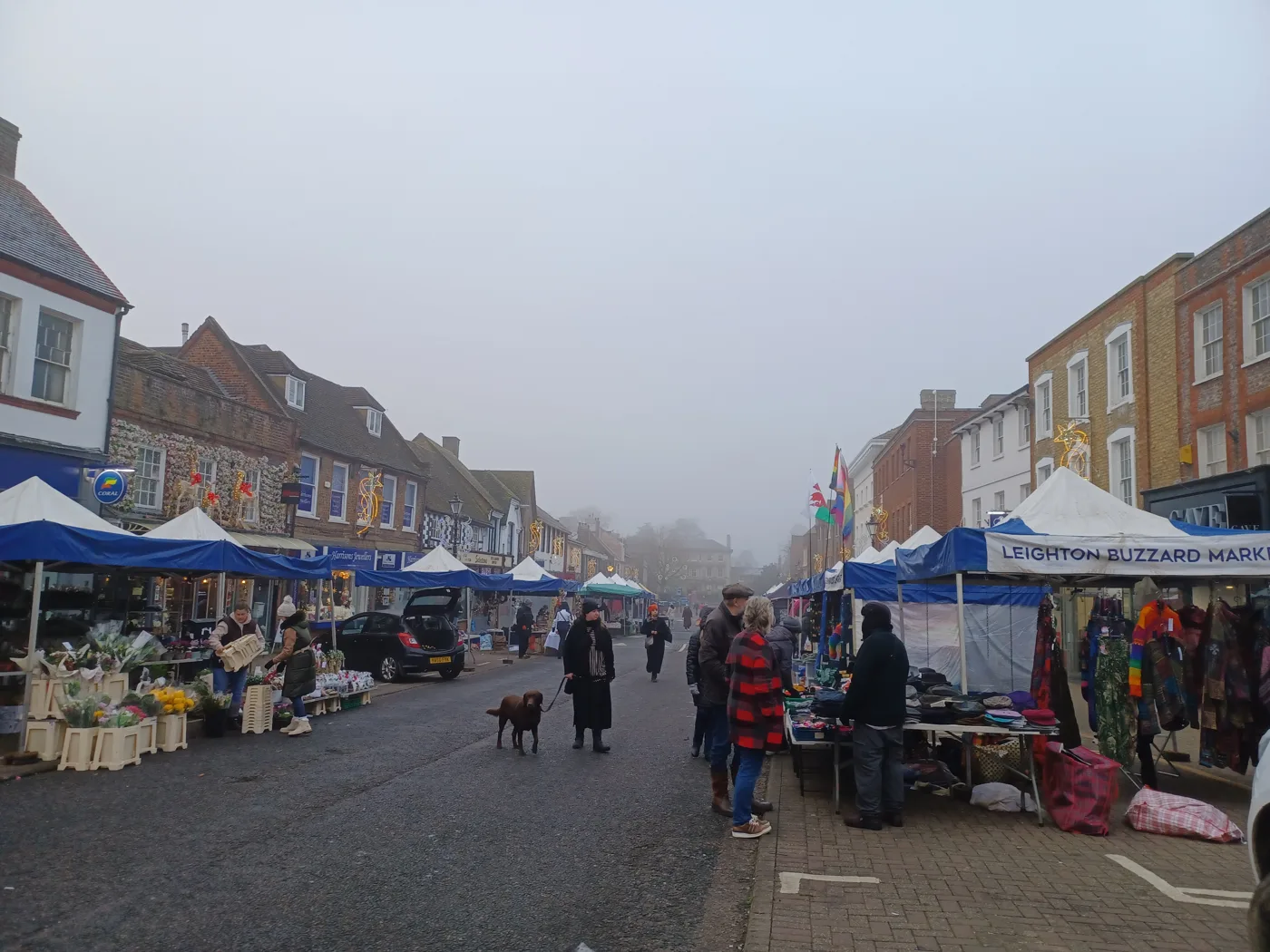
The market has run on the High Street for more than 900 years. The town’s market charter dates from 1208, one of the oldest in the country, and Leighton-Linslade Town Council took ownership of it in 2012. The strategy notes that the town once had the largest market in Bedfordshire, and that traditional Tuesday trading gave rise to the local saying “Tiddly Tuesday”.
The Tuesday problem
Historically Tuesday was the town’s farmers’ market, and the strategy says both days once drew similar numbers of traders and visitors. That has changed.
The document lists the reasons for the Tuesday decline:
- more households now have two working adults
- supermarkets have extended opening hours
- online grocery deliveries have reduced the need for a weekday shopping trip
- many part-time traders are only available on Saturdays
- communal seating and a dedicated food area have strengthened Saturday’s pull
The Market Sub-Committee heard on 20 August that market income was “broadly in line with historic trading patterns, despite weaker stall uptake on the Tuesday market”. Expenditure had been front-loaded by equipment and operating costs, and savings had come from using more town council staff.
Members at that meeting said the market “should be viewed as an investment in the vitality of the town centre”. No member of the public attended.
What the surveys actually found
The strategy is built on three separate pieces of research, and they do not all say the same thing.
Customer and trader consultation, early 2025
- 121 customers responded. 45% do not shop the market regularly, rising to 66% among those under 44.
- 75% said they would be more likely to attend with more seating, entertainment and food.
- 30 traders responded. 85% trade on Saturday only, and the strategy describes the trader base as “mature”.
- 80% of traders agreed that more seating, music and entertainment would benefit the market.
People and Places town centre survey, summer 2025
- Market day footfall has returned to pre-Covid levels and is 205% higher than the national average for small towns.
- 61% of town centre users named the market as a positive aspect of the town. Among businesses, 41% did.
Town council residents’ survey, May 2026 (512 responses)
- 86% of respondents use the market.
- 150 respondents asked for more stalls and greater variety.
- 43% put the market in their top three priorities for town council services, rising to 51% among those aged 65 and over.
- 17 to 24 year olds were less likely to use it, but made no negative comments about it.
Put together, those numbers describe a market that the town is fond of and a sizeable minority does not actually shop at. The generational split is the sharper finding: two thirds of under-44s were not regular customers in 2025.
What the plan proposes
Saturday is treated as something to protect rather than change. The strategy sets out a deliberately conservative Saturday approach: keep a consistent trader mix, fill vacant pitches with complementary businesses, and add entertainment at key trading times such as the run-up to Christmas.
Tuesday gets the reinvention. The stated aim is not to recreate the old farmers’ market but to build a weekday offer around people who are in town anyway. The objectives include:
- attracting new businesses and persuading existing Saturday traders to also trade on Tuesdays
- using the new electrical hook-up to build a dedicated food area with seating for workers and shoppers
- a Young Traders Scheme, work experience placements and market takeover events
- joint promotions with town centre shops so the market complements them rather than competes
- using demographic and footfall data to work out who is actually in the town centre midweek
The strategy also records what has already changed: the High Street is pedestrianised on market days, new tables, benches and lighter gazebos have been bought, buskers and social seating have been introduced, payments have moved to card and direct debit, and the market team has been restructured.
One cost has gone entirely. The strategy says the need for market security was eliminated by Central Bedfordshire Council’s use of ANPR to stop vehicles entering the High Street.
Two other decisions on the same papers
The 20 August minutes carry two further items that the committee is asked to note.
Trader representation. The sub-committee resolved that four trader representatives be appointed, to reflect different parts of the market: one Federation representative, one non-Federation representative, one Farmers’ Market representative and one Craft Market representative.
A policy review. Members found some market policies “outdated or inconsistent” and supported appointing an external consultant with market experience to advise, with adverse weather and market security named as the priority areas. That proposal is being referred to the Policy and Finance Committee, which meets on 21 September, rather than being decided on Monday.
What it means for you
The engagement period has not started yet, and Monday’s meeting is the thing that would start it. If you trade on the market, shop it, or have given up on it, this is the point at which the council is asking.
- The meeting is at 7.30pm on Monday 14 September in the Council Chamber at The White House, Hockliffe Street, LU7 1HD. It is open to the public and will be recorded.
- You can speak for up to three minutes on any item on the agenda, with 15 minutes allowed in total across the meeting.
- If you cannot attend, the informal engagement that follows is the route in. Watch the town council’s website for how it will be run, as the format has not been published.
- Final endorsement is expected at Full Council on 30 November, a date the town council’s calendar currently marks as provisional.
The market days themselves are unchanged in the meantime: the Charter Market runs Tuesdays and Saturdays on the High Street, with the Farmers’ and Producers’ Market on the third Saturday of the month, the Handmade and Craft Market on the fourth Saturday from March to December, Creative Buzz three times a year, and Streetfood Heroes on a Friday evening each month from March to October.
The High Street is closed to vehicles on market days, so if you are driving in, our parking in Leighton Buzzard page has the town centre car parks and tariffs, and our roadworks and travel page has what else is shut this week. More of what is on in town is on our things to do in Leighton Buzzard page.
Sources
- Leighton-Linslade Town Council, Cultural and Economic Committee meeting book, 14 September 2026 for the agenda and the recommendation on informal engagement, the notice of meeting dated 4 September, the venue, start time and public speaking rules, the draft Market Strategy 2026-2031 in full, and the draft minutes of the Market Sub-Committee of 20 August 2026 including the budget monitoring report, the trader representation resolution and the policy review referral.
- Leighton-Linslade Town Council, calendar of meetings 2026-2027 for the 19 November Market Sub-Committee, the 21 September Policy and Finance Committee and the provisional Full Council date of 30 November.
- Leighton-Linslade Town Council, committee papers for the published agenda and minutes of this committee.
Have your say