
About 40,000 homes in Dunstable and Leighton Buzzard qualify for a £100 energy payment in 2027, Alex Mayer MP says. What else is in the Budget, and when.
Around 40,000 households across Dunstable, Leighton Buzzard, Houghton Regis and the surrounding villages will get a £100 energy payment under the Budget announced today, according to Alex Mayer, the MP for Dunstable and Leighton Buzzard, who was in the Commons for the Chancellor’s speech.
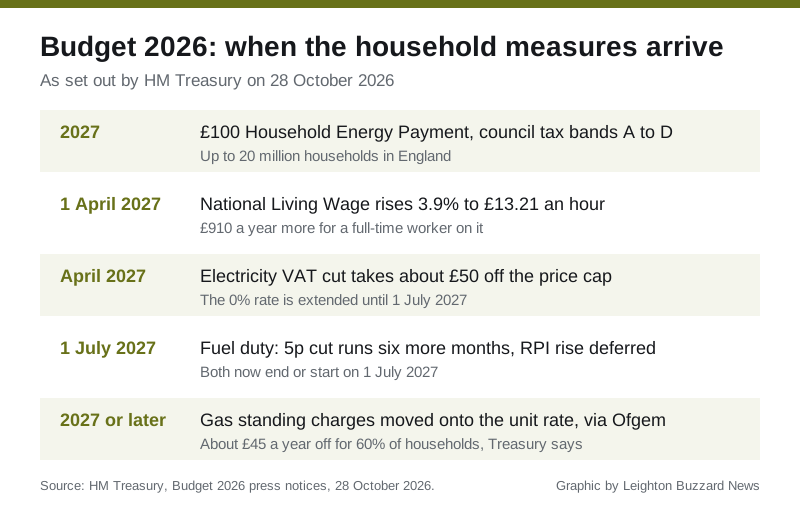
The Treasury’s own account puts the payment in 2027 rather than this winter: a £100 Household Energy Payment “for up to 20 million households in bands A to D in England”, meaning council tax bands A to D, with funding for similar help in the rest of the UK. (HM Treasury, Budget 2026: Breathing space for today, hope for the future, 28 October 2026) The Treasury has not yet said how or exactly when it will be paid.
The energy measures, checked against the Treasury
Gas standing charges. Ms Mayer’s release says an estimated 25,000 households in the constituency will save an average of £45 a year from the end of standing charges on gas. The Treasury says the Chancellor will ask Ofgem to remove them “in 2027 or as soon as possible after”, moving the cost onto the unit rate instead. It puts the typical standing charge at £108 a year and says the change “could save 60% of account-holding households around an average of £45” a year. The other 40% will not see an automatic saving, and the government says it will “set out in due course targeted mitigation for a small number of households”. (HM Treasury, Chancellor abolishes standing charges on gas bills, 28 October 2026)
In practice the households that gain most are those using little gas, since they currently pay the same fixed charge as a heavy user. A home that uses a lot of gas pays more of the cost through its unit rate.
VAT on electricity. The temporary cut in VAT on household electricity, which took effect at the start of this month, is extended until 1 July 2027. The Treasury says that takes around £50 off Ofgem’s annual price cap in April 2027. It is paid for by raising the Bank Corporation Tax Surcharge from 3% to 6% for 15 months.
What the MP said
Ms Mayer said:
“This Budget is about giving families some breathing space as global challenges swirl all around us.
“Energy bills are a big focus, and rightly so. Whether you’re putting the heating on, filling up the car or doing the weekly shop, those everyday costs really matter.
“I’m pleased the Chancellor is taking practical steps to put more money back into people’s pockets.”
On housing, wages and the shopping bill, she went on:
“For young people dreaming of owning their first home, this new scheme could help turn that dream into reality.
“Wages are up for everyone earning the Living Wage. For drivers, grappling with the effects of Trump’s war in Iran, fuel duty has been frozen again. And there’s action on imports to cut the costs of 100 every day foods including marmalade, a move Paddington Bear would surely approve of.”
Wages, pensions, fuel and first homes
- National Living Wage. It rises by 3.9% to £13.21 an hour on 1 April 2027, above £13 for the first time. The Treasury says that is £910 a year more, before tax, for a full-time worker. Ms Mayer’s office says 6,700 people in Central Bedfordshire are paid the National Living Wage.
- State pension. The release says pensioners will see the state pension rise by 3.9%. Separately, the Treasury says that from April 2027 anyone over State Pension age whose total income is no more than the new State Pension will pay no income tax, through a new Pension Tax Allowance.
- Fuel. The Treasury describes this as extending the 5p cut in fuel duty for six more months and putting off the planned inflation rise until 1 July 2027. Our Leighton Buzzard petrol prices page shows what local forecourts are charging.
- Food and imports. Tariffs come off more than 100 products. The Treasury names baked beans and chocolate among them, plus kerosene and fertiliser; marmalade is Ms Mayer’s example.
- First homes. The Your First Home Scheme, which the Treasury says will help 70,000 people onto the property ladder, sits alongside a new First Time Buyer ISA, which is out for consultation. From today the Lifetime ISA withdrawal charge falls to 20%.
No devolution deal for Bedfordshire
The part of the release with an edge is about devolution. Ten areas of England are named in the Budget as close to agreeing a mayoral or strategic authority. Bedfordshire is not one of them. The Treasury says the government “will continue working with all remaining areas including places like Bedford, Central Bedfordshire, Luton and Milton Keynes, where there is broad agreement but not yet local consensus to agree a Strategic Authority as soon as possible”, aiming for every area to be covered by the end of 2028. Today’s Budget also sets aside £285 million in 2027-28 for areas moving towards a deal.
Ms Mayer blames Central Bedfordshire Council. She said:
“I am disappointed that when Central Bedfordshire Council was offered a devolution deal, it did not rise to this important challenge.
“There are times when you should read the room. This is a PM who values and prioritises devolution. It’s where the cash, power and resources are. That could have been in the Budget today. They blocked it. Residents will be flabbergasted that councils couldn’t put differences aside to unlock multi-millions of regional funding.”
The council’s leadership has set out its own position. In September its leader, Cllr Adam Zerny, put a motion to Full Council backing an elected mayor over a wider Oxford to Cambridge area, rather than Bedfordshire and Milton Keynes alone, and asking for a public vote first: what that motion said.
What it means for you
- The £100 payment is tied to council tax bands A to D. You can check your band on our Leighton Buzzard council tax bands page. Nothing has been published yet on how it reaches households, so there is nothing to apply for today, and anyone asking for your bank details to “claim” it is not the government.
- Gas bills will not change this winter. The standing charge stays until Ofgem carries the change through, in 2027 at the earliest.
- Electricity keeps its 0% VAT rate until 1 July 2027.
- If you are paid the National Living Wage, your hourly rate goes to £13.21 from 1 April 2027.
We will add the payment details when the government publishes them.
Have your say