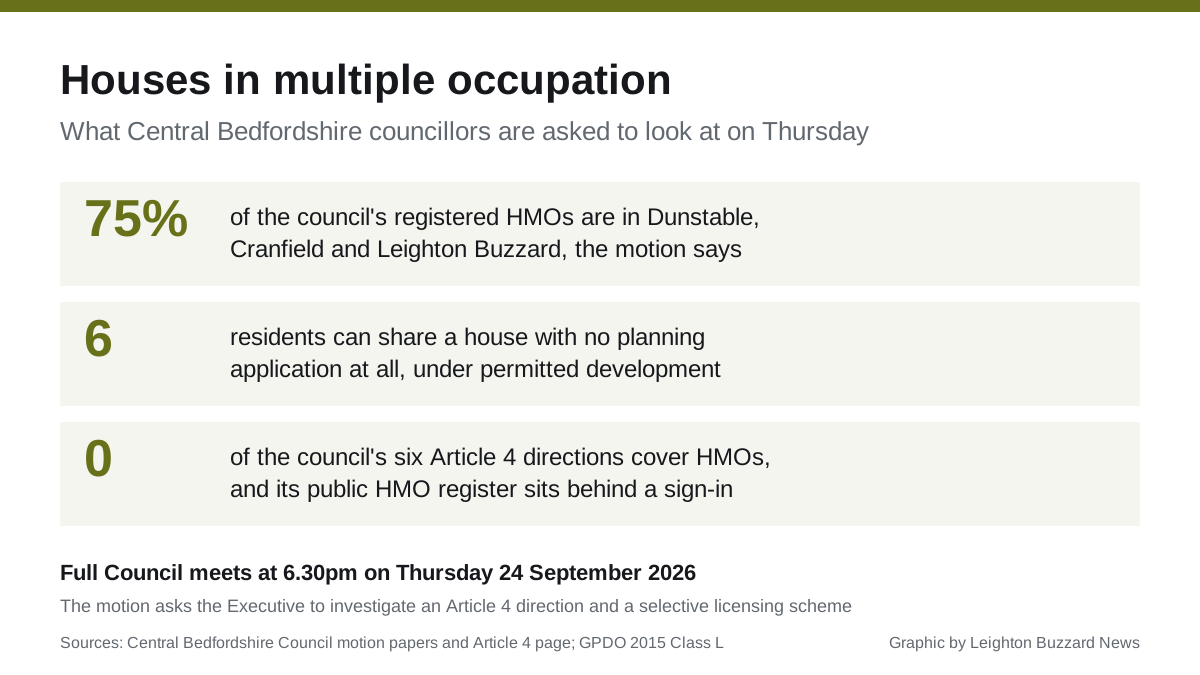

Leighton Buzzard is one of three towns holding 75% of Central Bedfordshire's HMOs, a motion says. Councillors debate planning curbs on Thursday.
Leighton Buzzard is named as one of three towns holding three quarters of Central Bedfordshire’s houses in multiple occupation, in a motion councillors debate on Thursday.
The motion is from Cllr Brennan and is item 14(c) at Full Council, 6.30pm on 24 September. It does not change any rule by itself. It asks the Executive to investigate two things:
- an Article 4 direction removing the permitted development right that lets a family home become a small HMO without planning permission
- a selective licensing scheme for parts of the private rented sector
The motion states: “According to CBC’s register, Dunstable has the highest concentration of HMO’s in the Central Bedfordshire Area. Dunstable, Cranfield and Leighton Buzzard account for 75% of all the HMO’s in CBC.”
Cranfield is about 11 miles north of Leighton Buzzard and Dunstable about seven miles south east. Cllr Brennan represents Dunstable North.
We could not check that figure, and nor can you
The council tells HMO tenants to look their own home up. Its tenants page says that if you cannot find your landlord’s licence “in our public register”, you should report it.
The link behind those words goes to
centralbedfordshirecouncil.sharepoint.com. Following it on Wednesday redirected
straight to a Microsoft sign-in page. There is no HMO register anywhere on the
council’s own website, and the planning register is a case-reference lookup that
cannot be searched by address or use.
So the 75% is the motion’s figure, taken from a register the public is invited to consult and cannot open.
What an Article 4 direction would actually do
Today, turning a family home into a small HMO needs no planning application at all in Central Bedfordshire.
That is because of Class L of the Town and Country Planning (General Permitted Development) (England) Order 2015, which permits a change of use “from a use falling within Class C3 (dwellinghouses) … to a use falling within Class C4 (houses in multiple occupation)”. Class C4 in the Use Classes Order is “use of a dwellinghouse by not more than six residents as a house in multiple occupation”.
An Article 4 direction switches that right off in a defined area. A landlord would then have to apply, neighbours would be consulted, and the council could weigh the effect of one more HMO in a street.
The council already uses Article 4 directions, but never for HMOs. Its published list runs to six places:
- Wrest Park Estate, Silsoe (floorspace changing from Class B1 to B8)
- Fairfield parish (roof enlargements, extra storeys, porches, from 5 January 2021)
- Toddington Conservation Area (extensions, porches, outbuildings, fences and more)
- Land at Lower Sundon (agricultural buildings)
- Husborne Crawley Conservation Area (as Toddington, plus exterior painting)
- Land around the Sandhouse public house, Watling Street, Heath and Reach (markets)
Heath and Reach is the only one on Leighton Buzzard’s doorstep, and it is about market stalls, not housing.
What licensing already covers, and what it misses
Two separate regimes are in play, and the motion asks about the second.
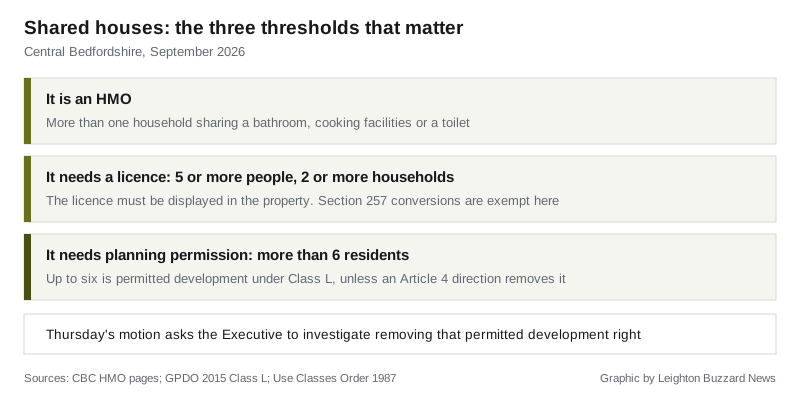
Mandatory HMO licensing already applies. The council’s own tenants page states that all HMOs “where 5 or more people form 2 households or more” need a licence from the council, displayed in the property. Its definition page sets the wider test at more than one household sharing a bathroom, cooking facilities or a toilet, and adds one gap worth knowing: “There is currently no requirement for section 257 HMOs to be licenced within Central Bedfordshire.” Section 257 covers poorly converted blocks of flats.
Selective licensing is different. It applies to ordinary private rented homes in a designated area, not only shared houses, and the council sets conditions on how they are managed.
The rules changed in the landlords’ favour on paperwork and against them on scope. Ministry guidance confirms that from 23 December 2024 councils “are no longer required to obtain confirmation from the Secretary of State before implementing a selective licensing scheme of any size”. A designation still needs at least a 10-week consultation and still has to meet the statutory tests in Part 3 of the Housing Act 2004, which include poor housing conditions, significant anti-social behaviour or high levels of deprivation.
What the motion says the problem is
The motion is careful about landlords. It says HMOs “when located appropriately and well managed, can provide valuable and affordable accommodation”, and that any intervention should be “proportionate, evidence-led and targeted at demonstrable local problems”.
The concerns it lists are inadequate housing conditions, overcrowding, waste and refuse management, parking pressure, noise and anti-social behaviour, and changes to the character of established residential areas.
What it means for you
- Nothing changes on Thursday. Even if the motion carries, it only asks the Executive to investigate. An Article 4 direction and a selective licensing scheme each need their own evidence base and consultation.
- A 10-week consultation is the earliest point you get a say on selective licensing, and the council has not started one.
- If you rent a room in a shared house of five or more people, your landlord needs a licence now and must display it. Complaints go to psh@centralbedfordshire.gov.uk.
- If a house near you is being converted, there is currently no planning application to object to unless it will hold more than six residents. That is the gap the motion is aimed at.
The meeting is webcast and residents can register to speak. The full agenda also carries a constitutional item that ends councillor call-ins on planning applications from 31 October.
More local information: Leighton Buzzard planning news and Leighton Buzzard house prices.
Have your say