
From 31 October a ward councillor can no longer force a planning application to a public committee. Central Bedfordshire votes on the rule change on Thursday.
Central Bedfordshire councillors vote on Thursday evening on constitution changes that end the power of a ward councillor to force a planning application in front of a public committee.
It is item 8a at Full Council, which meets at 6.30pm on 24 September at Priory House, Chicksands. The report is in the Leader’s name, Cllr Adam Zerny. It says plainly that the council has no choice: “The Council does not have discretion as to whether the new National Scheme of Delegation is implemented.”
The new rules start on 31 October 2026. They come from the Town and Country Planning (Discharge of Local Planning Authority Functions) (England) Regulations 2026, made under the Planning and Infrastructure Act 2025, with statutory guidance published on 1 June 2026. Every planning authority in England is covered.
What actually changes for a resident
Two routes to a committee hearing close.
- Ward councillor call-in. Under the council’s current scheme of delegation, a ward member or an adjoining ward member can ask in writing, on a set pro forma and with planning reasons, within 28 days of the application being notified, for it to go to the Development Management Committee. They then have to turn up and argue the reasons. That paragraph goes.
- The town or parish council objection. At present, a major application heading for approval must go to committee if a town or parish council has made a material planning objection that officers cannot resolve through negotiation or conditions, or if the application departs from the development plan. That goes too.
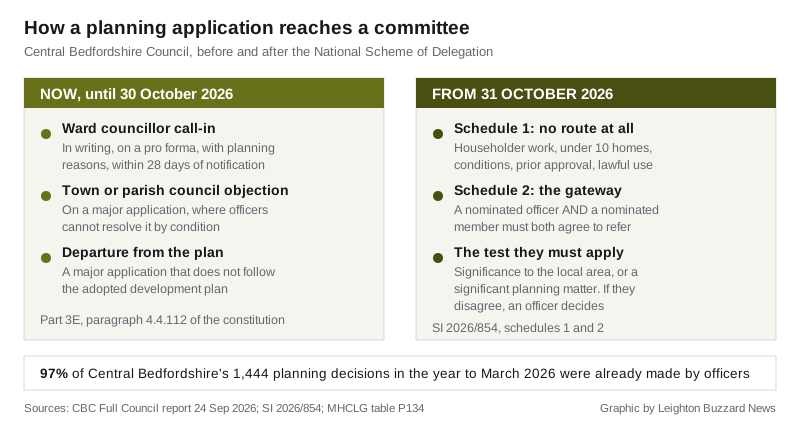
Both are set out in the tracked-changes version of Part 3E of the constitution, published as an appendix to Thursday’s report at paragraph 4.4.112.
In their place comes a national two-tier scheme. Schedule 1 applications must be decided by an officer, with no committee route at all. The report lists them:
- householder development
- minor commercial development, under 1,000 sq m or one hectare
- minor residential development, under 10 homes on a site smaller than 0.5 hectares
- discharge of planning conditions
- prior approval applications
- certificates of lawfulness
- non-material amendments
- certain reserved matters applications
- biodiversity gain plans
- permission in principle
Everything else sits in Schedule 2, where officer decision is the presumption. An application only reaches the committee if it raises an economic, social or environmental issue “of significance to the local area”, or a significant planning matter, and a nominated officer and a nominated member both agree to refer it. If the two cannot agree, the officer decides. The council’s revised terms of reference give the new test a name: the Member Referral, or “Gateway”, Test, with referrals made by the Chief Planning Officer.
Speaking rights at committee are not part of these changes. What goes is the route to a hearing, not the microphone once one is held.
The council objected, and was ignored
Central Bedfordshire responded to the government consultation in April 2026 and raised concerns about exactly this, “in particular, about the proposed removal of existing ward member call-in arrangements and the potential impact on local democratic oversight”.
Paragraph 15 of the report records what happened next: “The Government did not take these representations into account.”
The General Purposes Committee agreed the constitutional amendments on 27 August. Member training on the new scheme was held on 14 September, with a second session on Thursday itself, hours before the vote. The report warns that carrying on under the old rules would leave decisions open to judicial review and to being quashed.
Two live examples, on a committee agenda this morning
The Development Management Committee met at 9.30am on Wednesday 23 September. Two of the six applications on its agenda were there only because a ward councillor called them in.
One is a retrospective garden outbuilding and privacy screen at 1 Bankside Close, Houghton Regis, about six miles east of Leighton Buzzard. The officer report records it as “called-in” by Cllr Goodchild, on grounds including that it exceeds permitted development height by 300mm and overlooks the neighbouring house. Officers recommended approval.
That is householder development. From 31 October it falls in Schedule 1, so no councillor could have put it in front of a committee at all.
The second is 31 Northfields in Dunstable, about seven miles south east of the town, a change of use from a house to a children’s home for up to two children, called in by Cllr Brennan over parking, room standards and fire appliance access. Its officer report also recommends approval. After 31 October a call-in of that kind carries no weight on its own. It would need the two-person gateway to agree the application raises an issue of significance.
No application from Leighton Buzzard or Linslade was on Wednesday’s agenda.
How much this moves in practice
Most planning decisions here are already made by officers. The government’s own live table P134 shows Central Bedfordshire received 1,515 applications and made 1,444 decisions in the year to March 2026, with 97% delegated to officers and 84% granted. The England figure is 96%.
So the committee itself decided roughly 40 to 50 applications across the year, which matches its own agendas: six this week, four in August. Those are the decisions the two abolished routes were feeding.
The committee keeps 13 members. The regulations cap a planning committee at 13, and Central Bedfordshire already sits on the line, so nothing changes there.
The report does not say what happens to applications already referred to committee but not yet decided when the regulations bite on 31 October.
What it means for you
- Object now if you were going to. Until 31 October, asking your ward councillor to call an application in is still a live route, with a 28-day window from notification.
- After 31 October, write to the case officer, not only to your councillor. Representations still count and officers still have to weigh them. What no longer exists is an automatic path to a public hearing.
- A town or parish council objection stops being a trigger. Leighton-Linslade Town Council can still object to a major scheme, and that objection is still a material consideration, but it will no longer by itself send the application to committee.
- Watch for the gateway log. The statutory guidance recommends that councils record every case considered at the gateway, the outcome and the reasons, report them to the planning committee and publish them. That log is where you will be able to see how often referral is refused.
Thursday’s meeting is webcast, and residents can register to speak. The full agenda, including five other members’ motions, is on the council’s meeting page.
More on planning in the town: Leighton Buzzard planning news.
Have your say